
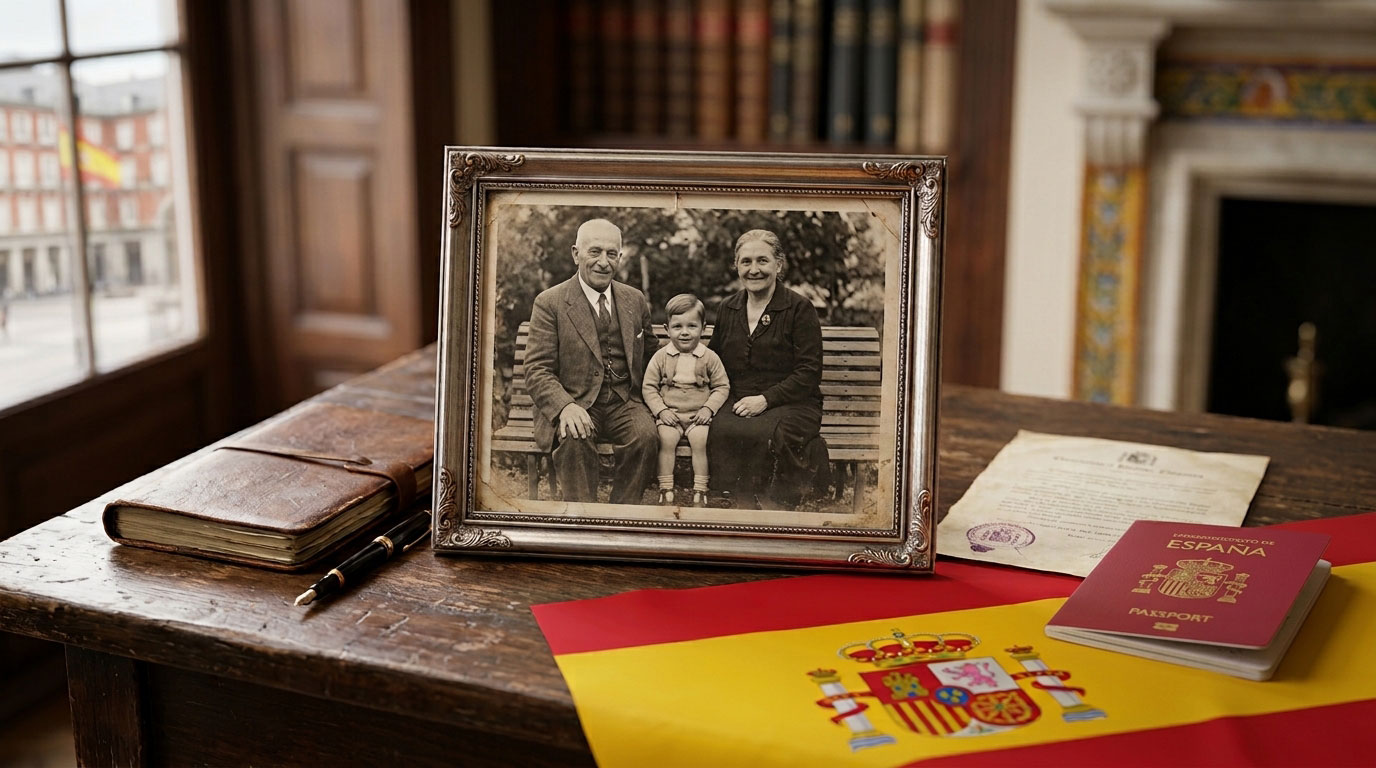
The so-called Grandchildren’s Law (Ley de Nietos) allowed certain descendants of Spanish citizens to apply for Spanish nationality of origin pursuant to the eighth additional provision of Law 20/2022 on Democratic Memory. However, in 2026, it is essential to distinguish between those who were able to apply through this pathway within the legal deadline, those who have already obtained nationality, and those currently seeking an alternative to establish themselves legally in Spain.
The so-called Grandchildren’s Law is not an independent law. The term is commonly used to refer to the eighth additional provision of Law 20/2022, which established specific cases for acquiring Spanish nationality by option.
Who Was Eligible to Obtain Spanish Nationality?
The regulation provided for the following cases, among others:
-
Individuals born outside of Spain whose father, mother, grandfather, or grandmother was originally Spanish and lost or renounced their nationality as a result of exile due to specific reasons.
-
Children born abroad to Spanish women who lost their nationality by marrying foreign citizens before the entry into force of the 1978 Constitution.
-
Adult children of individuals whose Spanish nationality of origin was recognized through certain pathways provided for in Law 20/2022 itself or in Law 52/2007.
Therefore, simply having a Spanish grandfather or grandmother was not sufficient in all cases. The possibility of applying under this pathway depended on meeting the legally established requirements and conditions.
What Documentation Was Required?
The process required documentary proof of the family link and, where applicable, the Spanish nationality of the ancestor and the circumstances of exile specified by law. The Instruction of October 25, 2022, set out the guidelines and documentation applicable to these procedures before the Civil Registry offices.
Validity of the Grandchildren’s Law in 2026
Can New Applications Be Submitted?
Not as an indefinitely open pathway. The eighth additional provision initially set a two-year period from the entry into force of Law 20/2022, with the possibility of a one-year extension agreed by the Council of Ministers. Therefore, in 2026, the ongoing processing of existing files should not be confused with the possibility of submitting new applications outside the legal deadline. Procedures initiated within the deadline must be analyzed according to the circumstances and documentation of each file.
What Has the Supreme Court Decided Regarding the Grandchildren’s Law in 2026?
The recent Supreme Court ruling has once again placed the Grandchildren’s Law at the center of legal discussions. However, it is important to correctly interpret the scope of the resolution and avoid drawing conclusions that the ruling does not establish.
The Origin of the Decision
The resolution addresses a question related to the effects of acquiring nationality and certain electoral rights. Therefore, analysis should focus on the specific legal issue resolved by the Supreme Court and which individuals and rights it affects, without turning the decision into a general conclusion about the validity of nationality acquired under the Democratic Memory Law.
How Does It Relate to the Electoral Register of Absent Residents (CERA)?
One relevant aspect falls within the realm of electoral rights and the status of certain citizens in the Electoral Register of Absent Residents (Censo Electoral de Residentes Ausentes or CERA). Nationality and voting rights are related, but legally they are not identical concepts. A modification or dispute concerning certain electoral rights does not automatically equate to a loss of Spanish nationality.
Does the Decision Mean That Spanish Nationality Is Lost?
It cannot be generally stated that an individual automatically loses Spanish nationality due to a matter related to the exercise of voting rights or registration in CERA. Nationality and electoral rights operate under different legal frameworks. Consequently, anyone who has received an administrative communication, has doubts about their electoral registration, or has had their status affected should specifically review the decision issued and its legal grounds.
Spanish Nationality and the Right to Vote: Two Separate Issues
A person’s electoral status and their condition as a Spanish national are distinct legal matters. A modification or incident related to electoral registration should not be automatically interpreted as a loss of Spanish nationality. For this reason, those who have obtained nationality through the Democratic Memory Law or have a pending application should analyze their specific situation before drawing conclusions about their rights.
What Happens to Those Who Have Already Obtained Nationality?
The outcome depends on how nationality was acquired and the specific circumstances of the case. An administrative or electoral incident must not be confused with an automatic loss of nationality. It will also be necessary to individually review the application, the legal pathway used, the documentation submitted, and the current status of the proceedings.
What Can Affected Individuals Do Currently?
When doubts arise regarding nationality already obtained or an application submitted under the Democratic Memory Law, it is advisable to:
-
Review the legal pathway under which nationality was requested or recognized.
-
Verify the documentation proving the family connection and compliance with the requirements.
-
Analyze any resolution or communication received from the authorities.
-
Determine the actual legal effects on your specific situation.
In nationality matters, subtle nuances in family background or documentation can significantly alter the legal outcome.
What Alternatives Exist to Live Legally in Spain?
The fact that a person cannot currently apply under the Grandchildren’s Law does not necessarily mean they lack a legal pathway to settle in Spain. Nationality and legal residence are distinct legal concepts. Depending on your personal, professional, and financial profile, other options may be available, including:
Non-Lucrative Residency
Designed for individuals with sufficient financial means who wish to reside in Spain without engaging in local employment or business activities.
Digital Nomad Visa
Aimed at professionals who perform their work remotely for companies or clients located primarily outside of Spain.
Residency for Highly Skilled Professionals
An option for qualified professionals who meet the established criteria to carry out a skilled professional activity in Spain.
Residency for Family Members
There are various residency pathways linked to the legal status of certain family members, depending on individual circumstances.
These alternatives do not replace Spanish nationality. They are distinct immigration pathways that can allow you to reside legally in Spain when access to nationality via the Grandchildren’s Law is not currently available.
Frequently Asked Questions About the Grandchildren’s Law
Is the Grandchildren’s Law Still in Effect in 2026?
The option pathway established by the eighth additional provision had a limited legal time frame. In 2026, it should not be considered an open option for new applications submitted out of time.
Can I Apply for Spanish Nationality Through My Grandfather Now?
Proving that a grandfather was Spanish is not enough on its own. Furthermore, the specific pathway under Law 20/2022 was subject to specific legal criteria and a strict deadline.
What Happens If I Have Already Submitted My Application?
The end of the deadline for new applications does not mean that files submitted on time automatically cease to be processed. The status of each case must be reviewed individually.
Can I Lose Spanish Nationality Due to the Grandchildren’s Law?
There is no automatic loss of nationality due to issues related to CERA or voting rights. Nationality and electoral rights are separate legal matters.
What Alternatives Do I Have If I Was Unable to Apply?
Depending on your circumstances, various residency pathways may be available in Spain. The right option will depend on factors such as your professional activity, financial resources, family ties, and personal goals in Spain.
What Is My Current Situation?
The Grandchildren’s Law created a specific pathway for certain descendants of Spanish citizens, but its application deadline should not be confused with current immigration options. If your goal is to live, work, invest, or settle in Spain, it is important to analyze your potential claim to nationality separately from available residency alternatives. If you are uncertain about your family background or whether it allows you to obtain Spanish nationality, at Asa Hutchinson Group we offer comprehensive advisory services to help you understand your legal options for establishing yourself in Spain. We analyze your case and the available pathways based on your personal circumstances. Request an evaluation today.